
Celebrate Rosie’s Congressional Gold Medal
We’re celebrating! Come join us.
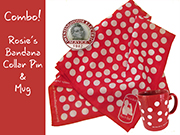
Did you know that Rosie the Riveter was just awarded the Congressional Gold Medal?
The day after Veterans Day, Thursday November 12, Congress passed the Rosie the Riveter Congressional Gold Medal Act. The act passed both houses and was signed into law on December 4.
Why the honor now? It takes determination and perseverance over many years to persuade Congress to award a Gold Medal. Rosie got her medal thanks to the tireless efforts of Mae Krier of Levittown, Pennsylvania
Who is Mae Krier? She’s one of the few remaining World War II Rosies. Now 94, she began promoting the need to recognize the important contribution that women made to winning WW2 back in the 1980s. And now, more than 30 years later, she gets to celebrate.
§§§ We’re ALSO Celebrating in Our Etsy Store: 20% off Orders of $25 CLICK HERE §§§
But that’s not the end of it. Krier is now working to get March 21st designated as National Rosie the Riveter Day. Many years this date is recognized, but only with a resolution passed in each specific year. House Resolution 162 and Senate Resolution 76 need to be passed so that one day each year can be automatically designated as National Rosie the Riveter Day.
How can you help? Contact your representatives in Congress and urge them to vote for March 21 as Rosie the Riveter Day. This will permanently acknowledge and celebrate the many contributions of millions of women who helped win WW2. Rosies, who are the embodiment of strength, courage, and empowerment, are role models for women today
And in addition, Krier hopes to live to see a Rosie statue at the World War II Memorial in Washington, D.C.
We’re Celebrating in Our Etsy Store: 20% off Orders of $25 CLICK HERE
EVERYTHING Rosie in our Etsy store is on our celebratory sale — Christmas Ornaments, Christmas Gift Feminist Power Pins, Rosie Posters, Rosie Mugs, Rosie Socks and, of course, our original and signature Rosie the Riveter red and white polkadot bandana and our historically accurate Enamel Rosie Employment Badge / Collar Pin and more.
Rosie the Riveter Congressional Gold Medal Act This bill directs the President pro tempore of the Senate and the Speaker of the House of Representatives to make appropriate arrangements for the award of a single Congressional Gold Medal to Rosie the Riveter (i.e., any female individual who held employment or volunteered in support of the war efforts during World War II), in recognition of their contributions to the United States and the inspiration they have provided to ensuing generations.
The medal shall be displayed at the National Museum of American History, which must make the medal available for display at other locations associated with Rosie the Riveter.
Rosie the Riveter – A Modern Take
Rosie the Riveter did what needed to be done. And in the doing, she supported America during World War II. And more than that, she supported other women. Some of these women were her co-workers, some were the daycare workers who looked after the children, some were roommates working different shifts, some were mothers and sisters. During WW2, women stood together to achieve unbelievable goals, knowing they could do it.
We decided to take a look at modern Rosie the Riveters. They are everywhere, in greater numbers and in more fields and occupations than would have been thought possible during WWII. And as we have seen, these women are standing strong. If you are on this website, then you are one of these strong women and you already support other women as they work to achieve personal and professional goals.
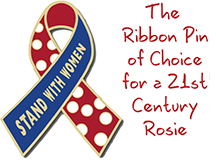
During WW2, Rosie the Riveter proudly wore an employment badge on her collar. You’ve seen that collar pin in the “We Can Do It!” poster. But what might a modern-day Rosie wear? We hope you will agree with us that as an empowered woman, we think she would want to wear our new STAND WITH WOMEN enamel ribbon pin that lets everyone know just where she stands… The pin will show the world where you stand as well.
Click here to purchase our lovely enamel pin from our Etsy store.
BUY THIS FEMINIST PIN for yourself or give this beautifully made Stand with Women enamel ribbon pin to friends and family. They will love it.
AND, get the add-on gift box…even give us the name of the giftee, her address, and how you want us to sign your name. We’ll get it right off to her. No fuss and worry on your side. Let us help you give a beautiful and lasting gift.

Our collectible feminist red and white polkadot ribbon pin was inspired by the Rosie the Riveter bandana. Rosie continues to stand for strong, empowered, courageous women. If Rosie were here today, we think this is the button she’d wear on her collar. And we bet she’d want her daughter to wear this pin as well.
You can show your attitude, your empowerment, your awareness with this ribbon pin.
Ribbon pins don’t change the world, but seeing a ribbon pin raises awareness of important issues. Standing with women and helping women achieve equality is one of those issues.
If you happen to be a pin collector — or know a pin collector — this is a great one to add to the collection of quality pins.
DETAILS – RED AND WHITE POLKADOT RIBBON PIN
— Rosie the Riveter inspired ribbon pin
— 1 inch size — large enough to see, small enough to wear everywhere
— Durable, hard enamel with gold metal
— Designed by us and made to our high-standard specifications
— Attached with single post/butterfly clutch fastener
— Delivered on a full-color, commemorative card
Channel Your Inner Rosie with this Stand With Women Enamel Lapel Pin — After all, the Future is Female
#WeCanDoIT
#EmpoweringWomen
#SuperWomen
#MeToo
#FutureIsFemale
#RosietheRiveter
#GirlPower
FEMINIST ENAMEL RIBBON PIN – SHOW YOU STAND WITH WOMEN (A 21ST CENTURY ROSIE THE RIVETER PIN)
{ 0 comments }
Happy Rosie the Riveter Day, 2019 (and Beyond)
Once Again Congress Has Declared March 21 as ROSIE THE RIVETER DAY!
The women who worked during World War II became known as Rosie the Riveters. Of course, they worked in many industries and held many jobs. But the name stuck and today is a convenient way to focus our attention and to pay our debt (or at least our thanks) to all those wonderful women who took on the jobs vacated by men who went to war.
And An Official Day of Recognition?
A Rosie who now lives in Marin County, California has spent years writing to Congress to get an official Rosie the Riveter Day. Finally, after years of spearheading the effort, Phyllis McKee Gould, now 97, saw the first Rosie the Riveter Day in 2017. She was even invited to Washington, DC for the day and continues to proudly display her photo with President Obama and Vice President Biden commemorating March 21, 2017.
She continues to write letters urging a permanent Rosie the Riveter day. Officials tell her it can’t be done. They tell her it is too hard. They tell her she shouldn’t try. But as you can well image, words of discouragement don’t stop a Rosie. Gould is pleased that the Senate passed the first resolution in 2017, followed again in 2018 and 2019 to declare March 21 as Rosie the Riveter Day.
But she still wants it to be permanent. She puts it this way:
“I want to be able to say on my marker ‘Mission accomplished.'”
What can you do?
Write to your Senator and state why you think there should be a permanent Rosie the Riveter Day. After all, their contributions were permanent and so should be their recognition.
What the resolution said
Interested in the words of the original Senate resolution?
March 21, 2017 has been designated National Rosie the Riveter Day in a ?collective national effort to raise awareness of the 16,000,000 women who worked during World War II.?
Let’s continue to raise awareness of the 16 million women who worked to help win WW2.
 WANT TO WEAR YOUR CAN DO ATTITUDE?
We have two great products in our Etsy RosiesLegacyGear and RosieGram stores that are super fun to wear and will let you show your Can Do attitude.

First, we offer a pair of red and white polkadot socks, custom made in our design. We even show a Rosie the Riveter on the back with the message, We Can Do It…Pass It On. We call these our Rock Your Dots Socks.
https://www.etsy.com/RosiesLegacyGear/listing/525492488

Second, we have just added a special three-pack gift set featuring three different Rosie the Riveter sock designs. One is called Rosies and has the silhouette of Rosie in yellow all over a blue background, topped with a red cuff with the word Rosies. (And we hid, in plain sight, a single yellow heart.)
The second pair of socks is called Hearts and showcases yellow hearts (and one yellow Rosie silhouette, of course) plus a red cuff.
The third pair of socks is our red and white polkadot ones. All three can also be mix-matched so that you have six pairs of socks. We designed them this way by using the same red, blue, and yellow — all taken from the famous Rosie the Riveter poster!
{ 0 comments }
Rosie the Riveter and Halloween
Post #92. Rosie’s Daughters: The “First Woman To” Generation Tells Its Story by Matilda Butler and Kendra Bonnett
Halloween is Coming
Halloween is in the air — or at least in all the stores. Have you noticed? I drove on 9th Avenue the other day and saw a giant black spider sitting nonchalantly atop our Goodwill Store. I walked into Michael’s to get some craft supplies and found shelves filled with metal and ceramic pumpkins and small bales of straw. And a quick trip to Costco showed me that costumes were already on hangars.
Yes, Halloween is definitely just around the spooky corner.
What will you be this Halloween? We have a suggestion for you. Consider being a Rosie the Riveter. Being Rosie is an appropriate costume for all ages. Your little daughter or granddaughter can show she’s growing into a strong, courageous, empowered woman. You can be a Rosie and remind your friends and co-workers that you are an empowered woman and you can “Rock Your Dots.”
And while we don’t have more of our Closeout Specials (see previous blog), we have an all-new Rosie Halloween Special. We even have an EARLY BIRD price on it.
This year we wanted to offer an inexpensive costume. AND it is now ready for you.
HALLOWEEN ROSIE THE RIVETER SPECIAL
• Authentic style Rosie red and white polkadot bandana
• Rosie the Riveter’s collar button
If you want to learn more, just click here.
To make this costume super affordable, we have introduced a 22″ by 22″ polkadot bandana. It is soft and still easy to tie in 1940s retro style. In addition, this size works for both adults and children. [If you want to upgrade, our authentic sized 27″ by 27″ bandana that was mandated by the Department of the Army during World War II is also available.]
And to complete the Rosie costume accessory set, we’ve included an employment badge like the one that Rosie wore on her collar in the famous “We Can Do It!” poster. Actually, women working in factories in World War 2 all wore employment badges. We researched the one where the poster was created and have replicated it in all its details. These were photo IDs and we put Rosie’s picture in the middle. All the colors are identical to the actual ones. This button is a steel pin-back, again letting us offer you a great costume at a great price. [If you want to upgrade, we also have a collectible Rosie Employment Badge that is made of 3-dimensional metal and is hand enameled.]
We hope you’ll check out this costume accessory set. Then just add your jeans and a work shirt…you’re ready to go as Rosie the Riveter.
And by the way, the bandana is great to use all year long in your pocket, in a purse, around your neck while working in the garden, etc. And the employment badge is super cute on a backpack or purse. Most costumes have no second acts. This one can become part of your regular accessories.
{ 0 comments }
Rosie the Riveter Bandana and Collar Button CLOSEOUT
Post #91. Rosie’s Daughters: The “First Woman To” Generation Tells Its Story by Matilda Butler and Kendra Bonnett
Rosie the Riveter Bandana and Collar Button CLOSEOUT
Before we share news about changes that are happening here at Rosie’s Daughters, we want to let you know about a special CLOSEOUT sale on a Rosie the Riveter Bandana and Collar Button Combo.
Rosie the Riveter and all women in the 1940s were careful with their money. It was wartime and if they had extra dollars, they were urged to buy war bonds to support the troops. But what if Rosie needed a new bandana?
To the rescue…our Rosie the Riveter Bandana and Collar Button CLOSEOUT sale that lets you be careful with your money today just as Rosie was during WW2.
What’s this all about?
First, begin with Rosie’s Bandana: We are offering the last of our silk screened bandanas. They are great. Thousands of women have purchased and worn these original Rosie Legacy Gear bandanas. Like all our products, the concept and design was carefully researched right down to the random pattern of polkadots and the size of the bandana — the same official 27″ by 27″ mandated by the Department of the Army.
Second, add Rosie’s Collar Button: We researched the design for these collar buttons down to the tiniest detail. In the “We Can Do It!” poster from World War II, Rosie wore her employment badge on her collar. That’s the concept behind our Rosie button. To keep it affordable, we printed our design on a 1.25 inch button (the size of the original employment badges).
Together at our first-ever CLOSEOUT price, they are perfectly paired.
 Get these Rosie the Riveter bandanas and Collar Buttons while they last…
• Outfit everyone participating in a team event, marching band, parade, school play, community function…or just about any gathering or get together where you want to show the strength, courage, and empowerment of women. They are super affordable so get as many as you need for your group.
• Or, just get one of these well-priced Rosie Bandana and Rosie Button Combos.
Either way, you’re a winner.
WHY A CLOSEOUT? If these are so great, you may wonder, why we are having a closeout sale? Good question.
These bandanas were made for us and to our specification when we thought our only option was silk screening. No existing fabric had the right random-pattern design and the typical bandana was smaller than the official size. But all of that has changed. We now have fabric dyed just for us in this same pattern so we no longer rely on silk screening. Our loss is your gain.
Here’s the math:
Rosie Bandana Originally Sold For: $20.
Rosie the Riveter Button Originally Sold For: $15.
Total: $35
We Originally Sold a COMBO OFFER For: $29.00.
You get this combo today at:
CLOSEOUT price of $8.70 (a sweet deal — that’s 70% off)
• ROSIE THE RIVETER BANDANA
— Silk screened red and white polkadot bandana
— Modeled after the bandana in the “We Can Do It!” WWII poster. Our design.
— World War 2 regulation size of 27″ by 27″
— 100% cotton fabric made in the US; silk screened in the US
• ROSIE THE RIVETER COLLAR BUTTON
— 1.25″ Rosie the Riveter Employment Badge Button
— Modeled after the button Rosie wore each day to work
— Steel pin-back button
— Anti-glare yet high gloss, weather-resistant finish
GET YOURS TODAY…WHILE THEY LAST. Once they are gone, the silk screened Rosie the Riveter bandannas will not be replaced.
 Thousands of women have worn our Rosie the Riveter Legacy Bandanas and Collar Pins. We hope you’ll join these other women in declaring your strength, courage, and empowerment. And be sure to send us your photo!
On to Other News
Kendra and I are in the midst of redoing and moving this website. There may be times when the website is down (as it was two days ago) due to our construction efforts. Many of you view our website on your mobile devices and we want to better accommodate you. This website is ancient in terms of smart phones and tablets. We’ve already done enough work to see that this will not be a quick fix, but it will be an exciting change.
Please forgive the mess we may create along the way.
We’ll get out to everyone once the website change is complete. Meanwhile, I no longer have access to email through rosiesdaughters.com. It will work in the future, but that will be at least a month. If you need to get to me, you can use my gmail account … butler.matilda@
Thanking you in advance for your understanding.
And don’t forget, if you are interested in a Rosie Bandana and Collar Button Combo, be sure to visit THIS LINK.
{ 0 comments }
FEARLESS – Rosie the Riveter
Post #90. Rosie’s Daughters: The “First Woman To” Generation Tells Its Story by Matilda Butler and Kendra Bonnett
UPDATE: Thursday, April 19, 2018
Watch out NYSE — here comes the Fearless Girl. In our article below posted earlier this month, we discussed the value of the word “fearless” as we apply it not only to Rosie the Riveter but to all women. One of our wonderful readers had taken her Rosie the Riveter Legacy Bandana over to the Fearless Girl statue in New York City, tied it on her, and snapped a photo that she shared with us.
But what was to become of Fearless Girl? She didn’t have a permanent home.
As of this morning, we had the great news that Fearless Girl will soon have a permanent home outside the New York Stock Exchange.
Perseverance is the attribute that has been important. The artist of the Charging Bull said that Fearless Girl took away from his sculpture and wanted it removed as soon as it was installed. Note that Charging Bull is an 11-foot-tall, 7,100-pound statue while Fearless Girl is 50 inches. More details are in the original article below.
But we just want to add one more item of interest — since the Fearless Girl statue was installed a little more than a year ago over 150 companies have added at least one female director to their boards.
I don’t know about you, but this is progress worth working toward.
¶¶¶¶¶¶¶¶¶¶¶¶¶¶Our Original Article¶¶¶¶¶¶¶¶¶¶¶¶¶¶
Fearless?
Rosie the Riveter is:
STRONG
COURAGEOUS
EMPOWERED.
But what about:
FEARLESS?
Women who worked during WWII, the “We Can Do It” generation, have become an important role model for follow-on generations. Rosies proved that women could tackle a wide variety of jobs in the workplace and do as well, and in many cases, even better than men.
The three adjectives we apply to Rosie the Riveter, Rosie’s Daughters, and all succeeding generations of women are “strong,” “courageous,” and “empowered.” For 2018 Women’s History Month, we’d like to add another adjective: “fearless.” Why?
FEARLESS may have always been a good way to describe women, but the past few months have focused our attention on just how fearless they (we) are. We’ve seen women stand up for their rights, seen them speak out against sexual harassment, and this past weekend we saw young women speak to a crowd of hundreds of thousands about the need to protect their lives — the lives of youth — from gun violence. All the speakers were amazing but one eleven year old, Naomi Wadler, addressed the large gathering with poise and grace that most of us cannot even imagine. This next generation of women are already fearless.
In the midst of new hashtags such as #metoo, #neveragain, #marchforourlives, #enoughisenough, we want to draw attention to a statue that was unveiled a year ago on International Women’s Day 2017. This sculpture is known as FEARLESS GIRL.
 You’ve probably seen pictures of it, but we have a special photo taken by a member of this Rosie’s Daughters community — Elizabeth Spiegl. She took her Rosie’s Legacy Bandana that we created and tied it on Fearless Girl. Then she took the picture and send it to us. Thanks Elizabeth.
Elizabeth has also started a petition to urge more women to be leaders. If you are interested, you can sign the petition at this link:
https://www.change.org/p/msnbc-desperately-needed-women-leaders
HERE’S TO WOMEN’S HISTORY MONTH.
Don’t know about Fearless Girl?
On International Women’s Day in 2017, the bronze Fearless Girl statue was installed across from the iconic Charging Bull near Wall Street. It was only to be there for a few days, according to the permit. However, it was instantly popular and so the permit was extended for one year — through International Women’s Day in 2018. That date has now passed. A change.org petition (signed by 40,000 people) asked New York City to make the statue a permanent installation.
The artist, Kristen Visbal, is working with the mayor’s office to either get another location for the statue or for it to be left in place. As of this blog post, no decision has been made.
{ 0 comments }
What Is the Real Rosie the Riveter Story?
Post #89. Rosie’s Daughters: The “First Woman To” Generation Tells Its Story by Matilda Butler and Kendra Bonnett
According to news reports today, the real Rosie the Riveter has just died at the age of 96.
 But wait a minute. Just a few years ago, newspapers reported that Geraldine Doyle, the real Rosie the Riveter, had died. We even wrote a blog post about her that we called: Geraldine Hoff Doyle: We Take Our Hats (Oops, Bandanas) Off to You
But Before We Go On…
Articles are announcing the death of Naomi Parker Fraley, the woman who is currently thought to be the inspiration for J. Howard Miller’s now-famous “We Can Do It” poster. But before we carry our own article, we want to propose that the real story is how Rosie the Riveter lives on in all the strong, empowered, courageous women in history, in the present, and in the future.
We cannot write this post without acknowledging the strength of the current #METOO movement and the broader recognition of the vital need for women’s voices in positions of power. Who would not become emotional seeing the gymnasts read their statements condemning their coach-abuser. Who would not cheer the women who have stepped up to run for political office. Who would not be ashamed for the tolerance of men who failed to promote women, who paid women less than men in the same job, who used their power to silence women. Who would not acknowledge that men have emotionally and sexually abused women in marriages and relationships as well as at work.
No more.
Women are speaking up and out. We must all do what we can. We all need to show our inner Rosie the Riveter. We need everyone to know that “We Can Do It!”
Today, we are again reminded of Abigail Adams’s March 31, 1776 letter to John Adams where she wrote these words of admonition:
…remember the ladies…all men would be tyrants if they could.
We appreciate the Rosie the Riveter icon for reminding us of our inner powers that we express.
Now, Here’s the Story about Naomi Parker Fraley
 Naomi Parker was a sister-Oklahoman. She was born in Tulsa in 1921 to Esther Leis and Joseph Parker. Naomi, along with her parents and seven siblings moved around the country until finally calling Alameda home. In 1942, just months after Japan attacked Pearl Harbor, Naomi and her sister Ada began work at the nearby Naval Air Station.
One day, an Acme photo agency photographer took a picture of Naomi while she was working at a lathe. That photo was published in the Oakland Post-Enquirer.
Decades later, James Kimble, a professor of communication at Seton Hall University in New Jersey researched the “We Can Do It!” poster that eventually became a feminist symbol. He knew of the photograph that was thought to be Geraldine Doyle but could not find a copy of it that included the original caption. Thanks to the Internet, he eventually found an antique newspaper dealer and was able to have a specific date, a place, and text. The article, published March 24, 1942, said:
“Pretty Naomi Parker looks like she might catch her nose in the turret lathe she is operating.”
The article went on to say, that women wore “safety clothes instead of feminine frills…And the girls don’t mind – they’re doing their part. Glamour is secondary these days.”
When Kimble went in search of Naomi Parker, he assumed she had died. But much to his surprise, he found that she was alive and well and living (once again) in Alameda. Kimble, upon the advice of his wife (women are so smart), made an appointment to meet Naomi (then Naomi Parker Fraley) and brought her a bouquet of flowers. She was thrilled that someone acknowledged her story that she was the face behind J. Howard Miller’s poster.
And now we have another part of the Rosie the Riveter story.
May All the Rosie the Riveters and Their Spirit of Empowerment, Courage, and Strength Flourish Forever.
PS We so like the strength in Abigail Adams’s words that we have just created a feminist tee showing Abigail as a young woman along with her quote. If you are interested, here’s a link to our Stand With Woman etsy store where we are selling the Abigail Adams t-shirt and other feminist items.
{ 0 comments }
Stand with Women
Post #88. Rosie’s Daughters: The “First Woman To” Generation Tells Its Story by Matilda Butler and Kendra Bonnett
Over the past 10 years, Kendra and I have talked with women about their life experiences, we’ve coached women who wanted to write their memoirs, and we’ve developed products as an outgrowth of the collective memoir we wrote about women born during WW2 — women who are often referred to as the “First Woman To” Generation.
So many of the stories we hear are intertwined with stories of abuse and sexual harassment in all its forms–from family members, boyfriends, husbands, employers, co-workers, etc. These are individual stories until there becomes a movement, a public statement from so many women that their stories become a collective story. There will be progress and there will be setbacks to bring about change, to stop the abuse and harassment. But no matter what, we Stand with Women.
Kendra and I have a much longer history of involvement in women’s issues than the past 10 years–more than 80 years if you combine them. And while we anticipate helping women at many levels in the coming years, we’ve decided that one thing we can do right now is to create a series of products that will allow all of us to show we support strong, courageous, empowered women…much as we have done with our Rosie the Riveter line of products.
We will soon be announcing the opening our of STAND WITH WOMEN store on etsy. This is an outgrowth of our years of involvement in women’s issues. Although our store isn’t officially open, we are posting a few products as specials. We are currently designing new enamel pins, socks, and t-shirts.
If you have a favorite feminist quote, or your own statement that you would like us to consider for our line of t-shirts, please send us an email at: Matilda(at)RosiesDaughters(dot)com. Or, you can put your quote in the Comment box at the end of this post.
While we are complete our design work, we thought you might be interested in some specials based on our “We Can Do It!” Rosie the Riveter product line. I’ve listed them below. You will notice that each of these has a price lower than on our RosiesLegacyGear etsy store. We’ve done this to celebrate our soon-to-be-official Stand With Women store.
(1) A special on 4 “We Can Do It!” FEMINIST MUGS that is 60% OFF. These are fabulous to use or to give.
CLICK HERE TO CHECK OUT AN AMAZINGLY LOW, 60% OFF PRICE.
(2) A 25% OFF offer on our “We Can Do It!” socks. These are the ones we call Rosie’s Toesies. I don’t know how long we’ll continue this low price, so you might want to go check them out. They make great stocking stuffers and Secret Santa gifts.
CLICK HERE TO SEE the 25% OFF OFFER.
(3) Our retro style Rosie the Riveter AUTHENTIC PIN lets you show the world you are a strong, independent, empowered woman. In celebration of the anticipated opening of our STAND WITH WOMEN Etsy store, we are offering this pin at a 50% DISCOUNT for a limited time. We continue to sell it at its regular price on our RosiesLegacyGear etsy store. So this is just a special for visiting our soon to be opened store.
CLICK HERE TO GET THIS TERRIFIC 50% OFF OFFER.
We hope you’ll share our Stand With Women news with your friends and family and join us today in celebrating Rosie the Riveter and all the strong, courageous, empowered women everywhere.
{ 0 comments }
Top 5 Halloween Costume Tips
Post #87. Rosie’s Daughters: The “First Woman To” Generation Tells Its Story by Matilda Butler and Kendra Bonnett
Who will you be this Halloween?
October is here and that means Halloween will arrive soon. Thinking about your Halloween costume? We’ve got five Halloween costume tips for you:
Tip #1: Be sure your costume is comfortable. Some costumes look great when you are standing in front of the mirror, but what about when you are at work that day or going to a party in the evening, or walking with your children while they trick or treat?
Tip #2: Make sure you are safe in your costume. Some masks make it difficult to see and elaborate headdresses can hinder your ability to move around safely. Long costumes may get in the way when you climb steps or want to dance and long sleeves that hang down over your hands can be a problem when it is time to snack or eat a meal.
Tip #3: Let your costume help you make a statement. You want others to recognize your costume and know that it is a reflection of who you are and your values.
Tip #4: Consider how your costume might work with your group of friends or your children. Find something that can be appropriate for different ages.
Tip #5: Decide on a cost effective costume. How about a costume with elements you can incorporate into your wardrobe after Halloween is over? Avoid costumes made of cheap materials that just end up being thrown away or stashed forever in the back of your closet.
 We’ve got a costume that meets all of these Halloween considerations. It’s our newly released ROSIE THE RIVETER HALLOWEEN COSTUME KIT.
[Click here to see our costume, available in our store on etsy.]
Meeting Tip #1: Rosie’s Costume Kit provides all the accessories for a definitely comfortable outfit. This is what Rosie and millions of working women wore to their jobs in factories during World War II.
Meeting Tip #2: Safety was critical during WW2 as well as today. Rosie the Riveter’s bandana was important to keep her hair away from machinery. She wore boots or workshoes. No high heels that may trip you up on a Halloween evening.
Meeting Tip #3: Halloween is a great time to make a statement about who you are and what matters to you. Rosie the Riveter is a symbol of strength, courage, and empowerment. That’s a fabulous message to share with friends, co-workers, family, and even strangers who see you in your “We Can Do It!” costume.
Meeting Tip #4: Group costume. Rosie and her colleagues all dressed similarly. You can do the same thing. You and a friend, or several friends, might all go as Rosie the Riveter. Or how about you and your daughter? We even have a great photo of a mother and son. It’s never too early to show respect for strong women.
 Meeting Tip #5: Cost effectiveness. Some costumes have become quite expensive and are usually a one-time use garment. This year, consider a Rosie costume that has high quality elements that you can use over and over again.
Actually our Rosie Costume Kit (check it out here) is currently on sale and provides BIG savings. The individual items are a $70 value that we regularly sell for $59.97. As a HALLOWEEN SPECIAL, the Costume Kit is just $39.97 this month. However, we do sell the items individually and we’ve included those links below.
With our ROSIE THE RIVETER COSTUME KIT, all you need to add is a pair of blue jeans from your drawer and a blue workshirt from your closet. You’ll be a Rosie the Riveter just as she is shown in the “We Can Do It!” poster.
Here’s what our Rosie the Riveter Costume Kit includes:
 ROSIE’S LEGACY BANDANA
• Full-size, 100% COTTON
• 27″ x 27″ (perfect for tying Rosie style, or for wearing around your neck anytime of the year)
• Same size as the bandanas MANDATED by Department of the Army in WWII for WOW (Women Ordnance Workers)
• Random polka dot pattern researched to be just like the one Rosie wore in the famous “We Can Do It” poster
• Fabric dyed just of us to be ULTRA SOFT…And a joy to wear all year long
If you want just the bandana without the entire kit, here you go.
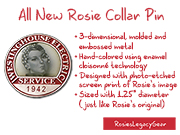 ROSIE’S EMPLOYMENT BADGE/COLLAR PIN
• Made using 3-dimensional, molded and embossed metal
• Hand-colored using enamel cloisonné technology (each one is slightly different, part of the hand process)
• Designed with a photo-etched screen print of Rosie’s image covered with clear coating
• Sized with 1.25″ diameter (just like Rosie’s original)
• Attached with single post/butterfly clutch fastener
• Unique, historically accurate, retro Rosie collar pin designed using an actual Westinghouse Electric Service employment badge, just like the one Rosie would have worn to work each day
• No one else has anything like this. You’ll feel like a real Rosie wearing this employment badge
• And wear it on your work shirt for Halloween and on your dress, sweater, vest or jacket all year long
If you just want this historically accurate WWII pin, here you go.
BTW: We wear ours all the time on shirts, sweaters, jackets, vests. It’s a great conversation starter. Our local postal clerk has worn hers on her jacket everyday for the past two years.
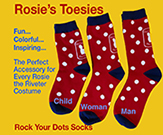 ROSIE’S TOESIES (AKA ROSIE’S RED SOCKS)
• 80% combed cotton, 17% nylon and 3% spandex
• Women’s, Men’s, Toddlers/Youths sizes (you choose)
• Norman Rockwell’s famous Saturday Evening Post cover of May 29, 1943 shows Rosie the Riveter wearing red socks. That made socks a must-have accessory.
• We added a few polka dots, figuring these were her second pair and so much more fun to wear than plain red. These are a NEW item and no one else has anything like this.
• And these are perfect for wearing with your favorite slacks or skirt throughout the year
If you want to purchase just these socks, here you go.
Want to see a little video about these super cute Rosie’s Toesies? Check it out!
 ROSIE’S POCKET ITEMS PACKED IN A DITTY BAG
These are totally authentic accessories–all things you can expect Rosies to have in their pockets during World War II: metal rivets, World War II ration tokens and a 1943 steel penny
If you are going to be Rosie, you definitely want these great authentic accessories:
• 3″x4″ Red and white polka dot organza drawstring bag
• Small handful of real machinist rivets (we’ve made our own mix of various sizes and grab a handful for each order). Plus Authentic 1943 steel penny (probably used during WW2 by a Rosie or her family) and ration tokens (necessary for purchases and handled by a Rosie during the war).
• Perfect to keep in your pocket and pull out when someone mentions your costume. Show them the rivets Rosie used, a steel penny only made in 1943, and a ration token given in change)
• Two Rosie the Riveter Temporary Tattoos! Fun, fun, fun.
• After Halloween, you might want to frame and display the 1943 penny and ration tokens…real World War 2 memorability.
• Descriptive card giving you a bit of historic information
We sell these separately as well as include them in your Rosie Costume Kit. Click here to order.
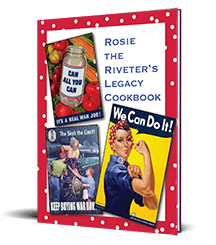 ROSIE THE RIVETER LEGACY COOKBOOK
• This is a fun little printed cookbook filled with recipes, history and pictures of WWII posters designed for the Homefront; we wrote and designed the cookbook.
• If you are giving a Halloween party, you’ll get ideas for your menu.
• If you are going to a Halloween party, you’ll find a dessert you can take with you to share.
[This item is not available separately. You can get a free ebook version by signing up in the column to the right.]
{ 0 comments }
Wouldn’t a Rally of Rosie the Riveters Be Great to See?
Post #86. Rosie’s Daughters: The “First Woman To” Generation Tells Its Story by Matilda Butler and Kendra Bonnett
A Roomful of Rosie’s … Including You!
The “We Can Do It!” poster, portraying a strong, empowered, courageous woman, continues to be popular and speaks to all women. The Rosie the Riveter Trust and the Yankee Air Museum hold annual events featuring this woman we now all call Rosie the Riveter. These two organizations have a friendly annual event competition, each striving to hold (or break, depending on your point of view) the Guinness World Record for the Most Rosie’s Gathered in One Place.
The photos are fun to see, but wouldn’t it be even better if you could participate. The Rosie the Riveter Trust has recently concluded their event in Richmond, California. And on Saturday October 14, the Yankee Air Museum — Willow Run Bomber Plant in Ypsilanti, Michigan, “will attempt to set a brand new World Record for the Most Rosie the Riveters. … The reason we are gathering at Willow Run to set a World Record is to support the Yankee Air Museum’s effort to save, preserve, and renovate Rosie’s historic World War II-era Willow Run Bomber Plant near Ypsilanti, Michigan.”
For more information about the upcoming event, click here.

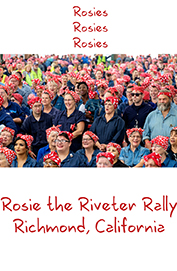 Meanwhile, have you seen all the Rosies gathered at the Rosie the Riveter Trust? To the left is one of the many photos taken at that terrific event.
Can’t Get to One of These Events?
You can always have your own Rosie Rally. Kendra and I have even put together a “We Can Do It!” Party Pack. Click here for details.
You Can Be a Rosie the Riveter with This Rosie Costume Kit
 Thinking of going to a Halloween party as Rosie the Riveter? We have our all-new, “We Can Do It!” Rosie the Riveter Costume Kit on a special sale for Halloween. Get yours today. Just click on the image to the left, or CLICK HERE.
Why Emphsize Rosie the Riveter?
Rosie Rallies are great and help to support worthwhile organizations who feature the importance of women during WW2. And, of course, the Guinness bragging rights are nice. Donning a Rosie the Riveter costume is fabulous and fun. Hosting your own “We Can Do It!” Party is a terrific idea.
…But this is about something bigger. This is about passing on the message of strength, courage, and empowerment to the next generation of women while thanking all the women who have come before us to open doors.
{ 0 comments }


 Subscribe to our feed!


